

Contents
A tech pack can look complete and still come back wrong because it leaves small decisions unspoken, and someone at the factory makes them for you. The width of a zipper shield. The elastic in a hood opening. Why the chest measurement grows from base layer to shell. None of it is left out on purpose. It just never made it onto the page.
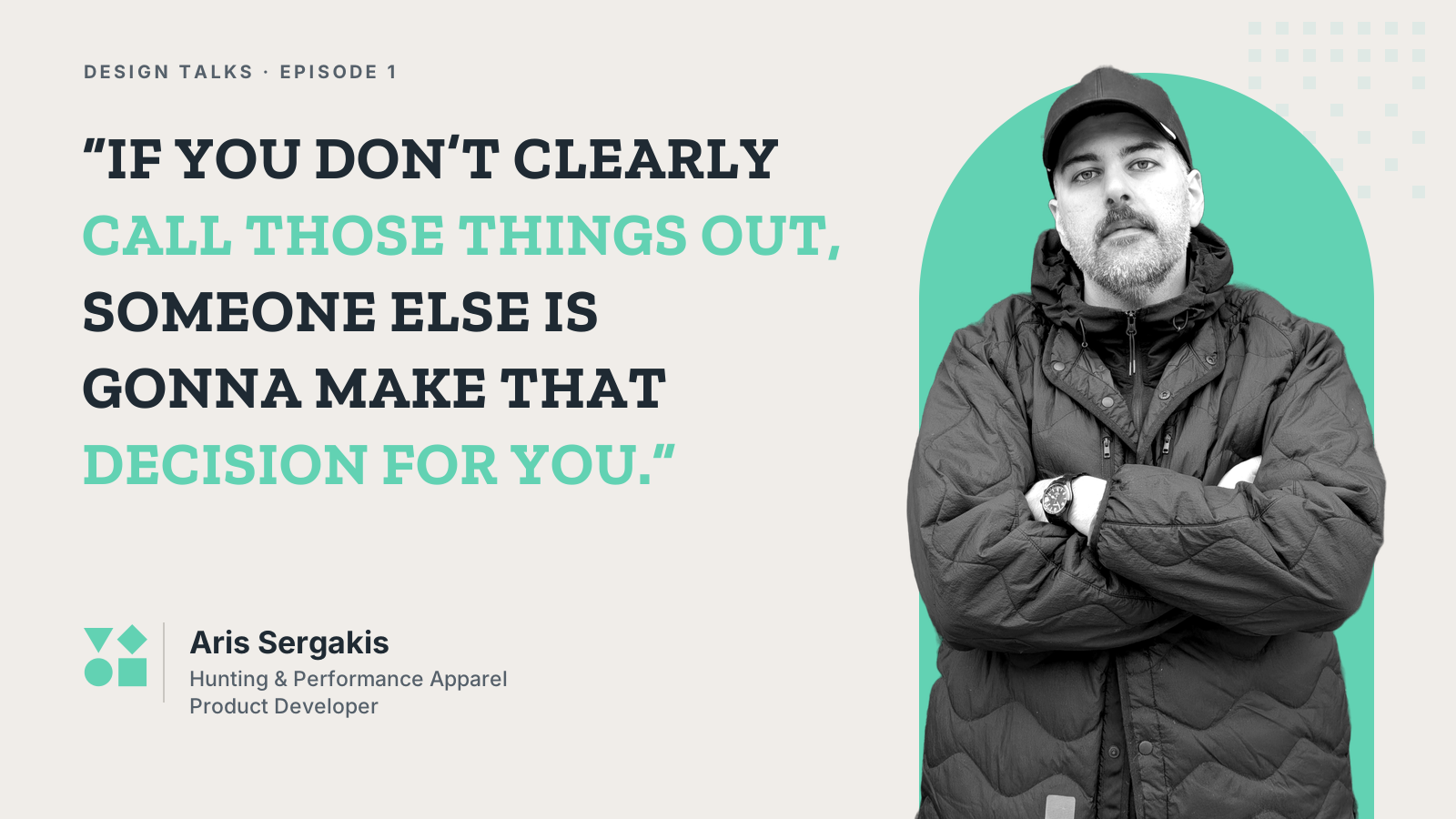
That gap is where we start the first episode of our new interview series. Each guest comes from a different product category, and every conversation comes back to the tech pack. Our first guest is Aris Sergakis, who designs and develops hunting and performance apparel after years in ready-to-wear in New York. Sayam sat down with him to ask how a tech pack holds a technical garment together, and where it quietly falls short.
Key takeaways
- A complete-looking tech pack still leaves gaps: Good factories stop and ask. Others decide for you, and you pay for it in extra comment rounds.
- Overseas development makes every spec matter: In Aris's experience, each sample takes four to five weeks to come back, so an unclear spec costs a full round.
- Layered garments need their logic explained: When a chest measurement grows on purpose across a layering system, say why, not just the number.
- Pictures cover what words can't: Reference images plus full-garment callouts and micro callouts carry intent better than text alone.
- Track every change in plain sight: Aris uses a comment page and a before-and-after measurement chart in each new round.
- Technical garments get long: Aris has seen tech packs for technical outerwear run to nearly 200 line items.
Chapters
- 0:00 Cold open
- 0:50 Why this conversation
- 1:12 Outdoor vs ready-to-wear
- 2:49 Developing overseas
- 5:02 When a "complete" tech pack still fails
- 7:06 Designing a system, not a garment
- 8:49 Reference images and callouts
- 10:02 Keeping tech packs consistent
- 12:18 What stays out of the tech pack
- 13:08 Running development as a team of one
- 14:18 If Aris built the software
- 16:54 What separates a factory that nails construction
- 17:53 SOPs in sampling
- 19:16 Libraries and physical samples
- 20:39 Tracking changes mid-development
- 21:57 The 200-line-item tech pack
- 23:38 Wrap-up
How is developing outdoor apparel different from ready-to-wear?
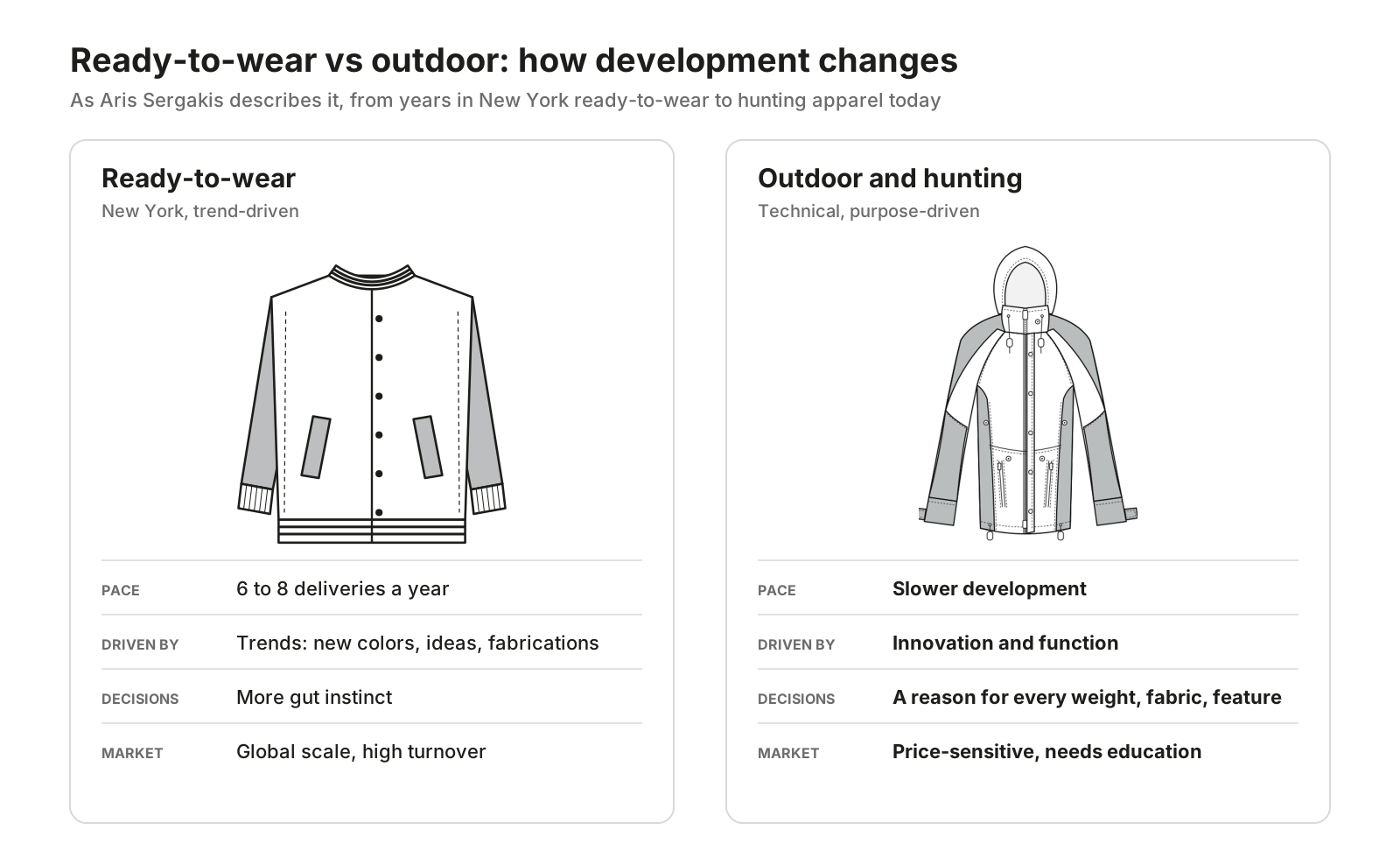
Outdoor apparel development moves slower and asks for a reason behind every choice. Ready-to-wear runs on trend, speed and volume. Outdoor runs on innovation and function, for a customer who is price sensitive, loyal to habits and needs to be shown why a new garment is better. Every weight, fabric and feature has to earn its place.
Aris spent years in New York, where brands shipped six to eight deliveries a year and chased new colors, ideas and fabrications. In outdoor, he described the work as "a little less of the gut instinct." Instead, he builds a justification for every decision.
"If something's too heavy, if something's too light, if something isn't durable enough, it's just not gonna cut it, and the guy or girl isn't gonna buy into it."
Takeaway for your team
- Write the purpose of each material and feature into your development notes. If you can't explain why it's there, your factory and your customer won't understand it either.
Why does overseas development demand more specific tech packs?
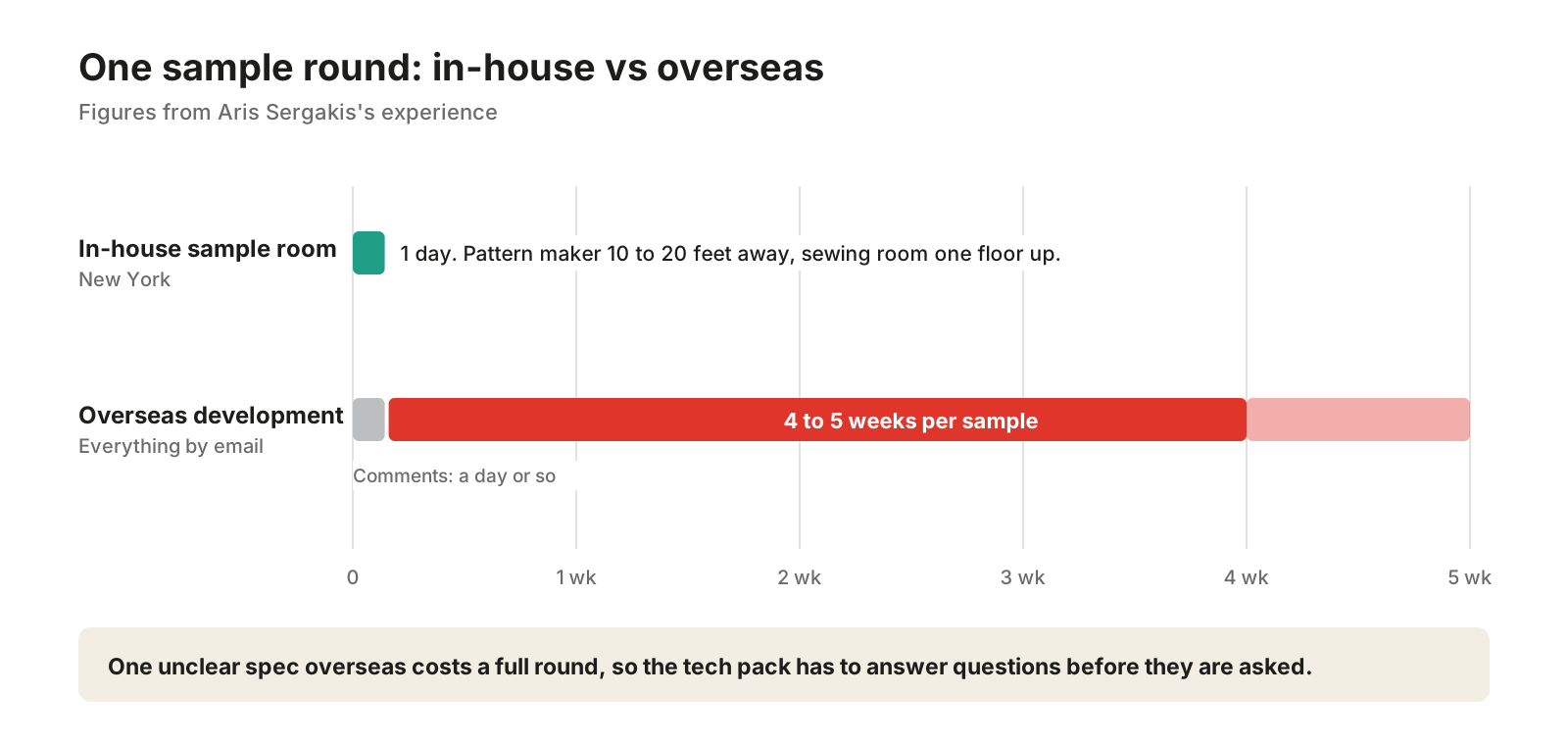
Overseas development removes the walk-over conversation that fixes problems in a day. Every question now travels by email, across time zones, and every sample takes weeks. So the tech pack has to carry what the pattern maker beside you used to fill in. For technical garments, performance targets must be settled before the tech pack even goes out.
In New York, Aris's pattern maker sat 10 to 20 feet away and the sewing room was a floor up. He could turn a sample around in one day. Now he develops everything internationally, waits a day or so for comments and four to five weeks for each sample.
"We're dealing with laminates, we're dealing with clo values that refer to body temperature fluctuations, weather fluctuations. All of that stuff has to be super clearly defined before you even launch the tech pack."
Takeaway for your team
- Agree on performance targets internally (laminates, insulation, clo values) before the first tech pack goes to the factory, not during sampling.
- Treat every email and tech pack as if no one can ask you a follow-up question today.
Why does a "complete" tech pack still come back wrong?
A tech pack comes back wrong when the sketch carries a detail the specs never state. If a measurement isn't written down, a good factory will stop and ask. A busy one may decide for you to save time. The sample isn't fully wrong, but it isn't what you meant, and it costs another round of comments.
Aris's example is a zipper shield. If you want it three quarters of an inch wide, you need to say so, not assume the sketch makes it obvious. The same goes for welt length and width, the elastic in a hood and the hood opening.
"If you don't clearly call those things out, someone else is gonna make that decision for you, and you're gonna end up with a garment that isn't necessarily 100% wrong, but you're gonna have to do more comments and more updates on it."
A measurement callout on the zipper shield in Techpack Builder, so the width isn't left for the factory to decide.
Takeaway for your team
- Before you send a tech pack, scan the sketch for any detail without a written measurement. Each one is a decision you are handing to the factory.
What do tech packs fail to say about layering systems?
Tech packs describe one garment at a time, but performance apparel works as a system. A base layer, a mid layer and outerwear, or in a 3-in-1 jacket a zip-in liner, mesh lining and shell, may share fabrics while their measurements change on purpose to allow for layering. Without that reasoning on the page, a factory reads the difference as a mistake and stops to question it.
Aris said this nuance of the full assortment is the thing tech packs most often fail to carry. The chest measurement grows from layer to layer, and the factory asks why the chart isn't consistent. Expectations around drape and material elasticity are also hard to make clear at the start.
"Why isn't my measurements chart consistent across all the chest?"
That is the question Aris hears from factories. He noted that it gets easier as the relationship grows and the factory comes to understand the line.
Example: a note beside the chest row in Techpack Builder explains why the measurement grows from zip-in liner to mesh lining to shell, so the factory doesn't read it as an error.
Takeaway for your team
- Add a short note wherever a measurement breaks the pattern on purpose, and name the layer it is designed to go over.
How do reference images and callouts fill the gaps?
Reference images and callouts carry what written specs can't. A firm measurement chart and grade rules set the numbers. Reference images show how something should look and behave. Callouts on the sketch point to exactly where each instruction applies, from the whole garment down to a single zipper or cuff.
Aris stays hard-lined on his measurement charts and grade rules inside the tech pack. Over email, he sends reference images so the factory can see how something should operate and how the broader market handles it. "Reference images are huge," he said.
"I'll have individual callouts for the full garment and then micro callouts on zipper specs, cuff adjustments, things like that."
Full-garment callouts, then micro callouts for the collar, zip, pocket zip and cuff tab, pinned to a hunting jacket sketch in Techpack Builder.
Takeaway for your team
- Use two levels of callouts: one set for the full garment, and micro callouts for trims and small components.
- Keep reference images next to the detail they explain, so they don't get lost in an email thread.
How do you keep tech packs consistent across styles and seasons?
Consistency comes from a fixed layout and format, not from a particular tool. Libraries of trims, materials and construction details help. When every tech pack follows the same structure, a factory learns to read your packs, and your team stops reinventing them each season.
Aris said time is the main challenge, especially with a new factory. Early on he is hyper-specific about every inch of the garment. Season over season, as trims and materials repeat, the factory understands more. He has built tech packs in dedicated software, Illustrator and Excel. Excel, he admitted, is workable but a time waster.
"As long as it can be consistent, style to style, it really doesn't matter as far as category as long as the layout and the format is the same."
Takeaway for your team
- Lock one tech pack layout and reuse it across every style and category.
- Be more detailed with a new factory than you think you need to be, and trim back as trust builds.
Do certifications and test results belong in the tech pack?
In Aris's process, certifications and test results stay out of the tech pack. They live in a separate deck that briefs the marketing team, so performance claims reach the customer. Factories get testing information from fabric vendors and run their own checks on water columns, snaps and zippers.
Aris uses that deck for values such as clo and water column ratings. The factory runs water column tests and tension tests on snaps and zippers anyway.
"If I need my factory to do the testing, they're gonna get that information from my fabric vendors."
Takeaway for your team
- Decide where performance data lives and who it serves. The tech pack tells the factory how to build; a separate document can tell marketing what to say.
What does product development look like with a team of one?
With a team of one, the same person carries a garment from idea to website. There is no merchandiser, developer or director of development to share the load. That makes clear documentation even more important, because there is no one else holding the context when a factory question lands.
Aris currently runs design and development alone, alongside one marketer. In earlier roles he led larger, more traditional teams with merchandisers, designers, developers and a director of development. He said his hands were always in the tech pack work, because he came up through every stage of the garment's life cycle.
"I am ideating. I am creating the assortment. I'm sourcing fabrics and trims. I'm designing. I'm developing. I'm doing the fittings."
He also writes the website copy.
Takeaway for your team
- If one person holds the whole process, write down what lives in their head. The tech pack is the backup when they are not in the room.
What would Aris build into tech pack software?
Aris would build inventory visibility into the moment of design. When he nominates a fabric or trim for a new style, he wants to see how much stock is left. A low count could decide whether a style is worth developing at all, given long lead times for new material.
His example is a visual marker that warns him when a fabric is under 50 yards. Making and dyeing more could take 60 to 120 days before bulk is ready. The same applies to trims, like a bias tape with 100 yards left or 50 snaps in stock. That data has to come from both sides, the brand and the manufacturer, and could sit with a demand, planning or merchandising team.
"As I start to nominate trims and fabrics for a new style, I can have a visual marker that tells me, hey. You have less than 50 yards in this. Do you wanna develop this style?"
Takeaway for your team
- Check material and trim stock before you commit to developing a style, not after the purchase order is placed. Ask your planning team or factory for current counts early.
What separates a factory that gets construction right?
The factories that get construction right are the ones that communicate. When a tech pack is incomplete, they raise it and ask questions instead of guessing. They don't take on the risk of deciding for you. That habit, plus time spent building the relationship, is what keeps construction details accurate.
Aris said a strong factory makes sure the brand makes the decisions. He added that the brand owns its share too: being clear about the materials it nominates, how they should work and what it expects from the garment.
"They're not going to be the liability when they make the decisions for us. They're gonna make sure we make those decisions."
A manufacturer's question pinned to the stand collar callout in Techpack Builder, asked before sampling instead of guessed.
Takeaway for your team
- When you evaluate a factory, count the questions it asks on a first sample. A factory that asks is protecting your design.
Why are SOPs hard to apply during sampling?
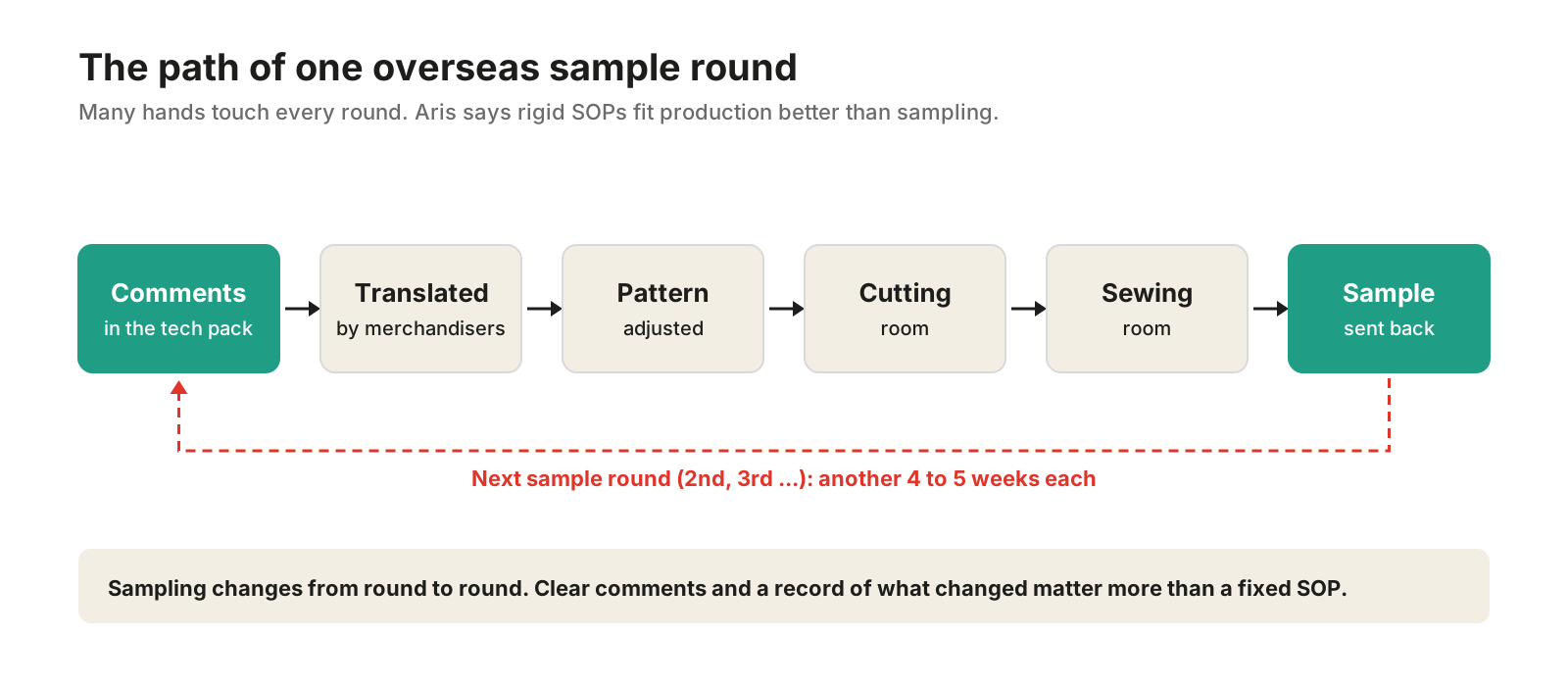
SOPs are hard to apply during sampling because sampling keeps changing. Each round passes through translation, pattern making, cutting and sewing, with many hands involved. Production should run on well-defined SOPs. The front end of development needs more room to adjust from sample to sample.
Aris has used SOPs at other companies but doesn't currently. He described the path a sample takes overseas: his comments are translated by merchandisers, patterns are adjusted, and the work moves to the cutting room and then the sewing room.
"It's really like the sample portion, the front end of the development leading up to that, that takes a little more finesse because it isn't a kind of static process."
Takeaway for your team
- Save rigid SOPs for production. In sampling, focus on clear comments and a record of what changed each round.
When does a physical sample beat a tech pack?
A physical sample beats a tech pack when the detail is about hand feel, finish or a construction that is hard to draw. Sending a real pocket, a taped seam or even a pattern shows the factory exactly what you expect. Aris uses physical references most when he brings a known material to a new factory.
Aris keeps physical construction samples hanging in a labeled section, such as pockets and seam taping. Taping matters in his category, because different materials need different heat and cooling times. He has also sent his own patterns to show the factory exactly what he wants. Doing that, he said, puts you a mile ahead.
"A tech pack can only go so far."
Takeaway for your team
- Build a physical library of approved constructions, labeled with the settings that matter, such as tape heat and cooling times.
- When onboarding a new factory, send a physical standard alongside the tech pack.
How do you track changes to a tech pack mid-development?
Track tech pack changes so the factory can see exactly what moved. Label each round clearly, highlight changes on the sketch, and add a comment page that states what it was and what it is now. A before-and-after measurement chart makes the update impossible to miss.
Aris labels each sample round P1, P2 and P3. He highlights updated sketches and adds a dedicated comment page. His measurement chart shows before and after columns, highlighted manually. As development progresses, the old column shifts out so no one gets confused.
"I'll have a whole comment page that is dedicated to this was like this, and now it's like that. This used to be measured here. Now it's measured here."
The block history of a sketch in Techpack Builder, logging who changed what and when, including a pocket zip moved ½" lower.
Takeaway for your team
- Never send a new round without a change summary. Show the old value and the new value side by side.
- Remove outdated columns once the factory has confirmed the change, so only one number is live.
Why do technical garments need tech packs with nearly 200 line items?
Technical garments need long tech packs because they have many small parts, and each one is a spec. Waterproof and insulated pieces carry laminates, tapes, trims and hardware that all need part numbers. If a component isn't written down, it can be lost or swapped along the way.
Aris said a long, detailed tech pack makes sense once you build out a technical garment. A single jacket can carry 10 to 20 quarter-inch eyelets, something you barely think about until you list every part.
"Your tech pack can be nearly 200 line items. There could be 200 different articles and part numbers in there for individual specs."
Adding an eyelet line to a hunting jacket BOM in Techpack Builder. Every eyelet, snap and length of seam tape gets its own line and part number.
Takeaway for your team
- Give every component, down to eyelets and snaps, its own line and part number. If it isn't expressed, it isn't controlled.
What this conversation taught us about tech packs
The biggest lesson from Aris is that a tech pack rarely fails because something is wrong. It fails because something is unsaid. When development happens across an ocean, every unsaid detail becomes a decision someone else makes, and a four-to-five-week wait to find out.
Here's what to take back to your team:
- Write the decision, not just the drawing: If a width, length or elastic tension matters, put the number on the page.
- Explain the logic behind the numbers: Layering systems and intentional measurement jumps need a note, or the factory will treat them as errors.
- Show, don't only tell: Callouts at two levels, reference images and physical samples carry intent that text can't.
- Make every change visible: A comment page and a before-and-after chart save a round of confusion each time.
As Aris said at the end of our talk, it's fun to talk about "the other side" that not a lot of people know about. That is exactly why we started this series.
If the gaps Aris describes sound familiar, Techpack Builder lets you pin callouts, notes and reference images right where they apply on the sketch, with a block history of every spec change. Try it on your next style.
And if you want to follow the series, join our newsletter. We will be talking to experts from different product categories about how they develop products and how the tech pack holds it all together.
Frequently asked questions
What should a tech pack include for technical outerwear?
A tech pack for technical outerwear should include a firm measurement chart and grade rules, full-garment and micro callouts, reference images, and a line for every component with its part number. In Aris's experience, performance targets such as laminates and clo values should be defined before the tech pack is sent.
Why does a factory get a tech pack wrong when it looks complete?
A factory gets a complete-looking tech pack wrong when a detail appears in the sketch but not in the specs. Aris's example is a zipper shield width. A good factory will ask. Others decide for you to save time, and the sample comes back close but not right.
How do you track changes in a tech pack?
Aris labels each round (P1, P2, P3), highlights updated sketches and adds a comment page that says what changed. His measurement chart shows before and after columns side by side. As development moves forward, the old column is removed so the factory only follows the current value.
How long does overseas sampling take?
In Aris's experience, an overseas sample takes four to five weeks to come back, and email comments take a day or so. With an in-house sample room in New York, he could turn a sample around in one day. That gap is why overseas tech packs need to be more specific.
How many line items can a technical garment's tech pack have?
Aris said a tech pack for waterproof or insulated garments can run to nearly 200 line items, with as many as 200 different articles and part numbers. A single jacket might carry 10 to 20 quarter-inch eyelets. If a component isn't expressed in the tech pack, it can get lost along the way.
Do certifications belong in a tech pack?
In Aris's process, they don't. He keeps clo values, water column ratings and similar data in a separate deck for his marketing team. Factories get testing information from fabric vendors and run water column and tension tests on snaps and zippers as part of their own process.
When should you send a physical sample?
Send a physical sample when a detail depends on hand feel, finish or a construction that is hard to draw. Aris sends physical references when bringing a known material to a new factory, and has even sent his own patterns. In his words, a tech pack can only go so far.
How is outdoor apparel development different from ready-to-wear?
Aris describes ready-to-wear as fast, trend-driven and large scale, with six to eight deliveries a year. Outdoor apparel is slower and focused on innovation. Customers are price sensitive and need education, so every material, weight and feature needs a clear purpose before it makes it into the line.
Key terms
- Tech pack: The document that tells a factory how to make a garment, from sketches and measurements to materials, trims and construction.
- Callout: A labeled note pointing to a specific spot on a sketch, explaining a measurement, trim or construction detail.
- Grade rules: The amounts each measurement changes from one size to the next across a size range.
- Clo value: A unit that measures how much thermal insulation a garment or clothing system provides.
- SOP: A standard operating procedure, a documented step-by-step process a team or factory follows the same way every time.
Related reading
- Standardizing Seams in Fashion: From Construction Diagrams to Clear Manufacturing Communication, our conversation with Belu of ABC Seams on why factories read the same seam differently.
- Optimizing fashion workflows, with Amanda of ARD Consultancy.
About the guest
Aris Sergakis designs and develops hunting and performance apparel, where he runs design and development as a team of one alongside a marketer. Before moving into outdoor, he spent years in ready-to-wear in New York, working with in-house sample rooms and leading teams of designers, developers and merchandisers. Connect with Aris on LinkedIn.