
Contents

If you work in activewear, you have probably opened a sample that looked perfect on the table and failed the moment someone moved in it. A waistband that rolled on the first squat. A seam that started rubbing halfway through a run. A pair of leggings that went sheer the second they stretched.
Activewear looks like one of the simplest categories in fashion. A pair of leggings, a sports bra, a running short. But these garments are built for bodies in motion, and that changes how they are designed, specified and sampled. It is also a category where a vague tech pack gets expensive very quickly.
In the second episode of Design Talks, former Adidas Design Director Courtney Evors walks us through what makes activewear different, why a fabric change means a pattern change, and what a tech pack needs to say beyond the sketch. For this blog, I am drawing on a conversation between Sayam Kochar, co-founder of Techpacker and host of this series, and Courtney Evors, founder of The Consultancy KTCHN. Courtney started out in high-end fashion, moved into activewear with Fila, and then spent thirteen and a half years at Adidas, where she was a Design Director, working across product design and product marketing. Today she helps growing active and lifestyle brands make better product decisions. As she describes it, she is the person who can "come in and spot rather quickly what's broken in the process." Her examples are some of the clearest I have heard on why activewear needs its own approach, so I have woven them through this guide. It is part of our series on how product development works across different categories, and I hope it gives you a few things to take back to your team.
Why Activewear Product Development Is Harder Than It Looks
Fashion product development usually starts with how a garment looks. Activewear starts with what the body will do in it. Courtney's first question for any product is simple. "What am I building this for?"
The answer changes almost everything. Running, training and tennis move the body in different ways, so they need different seams, fabrics and trims. Here are a few of the differences Courtney walked through.
- Seams are built for friction. Over a marathon, a seam in the wrong place will chafe unless it is flatlocked or sewn with the right thread on the inside.
- Fiber is chosen for sweat. Synthetics wick moisture away from the body and stay lighter, while cotton gets heavy when you sweat. Wool is its own story, with trade-offs in stretch, comfort, hand feel and cost.
- Every trim needs a reason. Courtney's personal pet peeve is a zipper at the center back of tights or shorts. It is exactly where sweat runs when you are running, and it is the first thing that digs in when you lie on your back for a hamstring stretch.
"If I need to do a hamstring stretch and I'm on my back, what digs in first? The zipper."
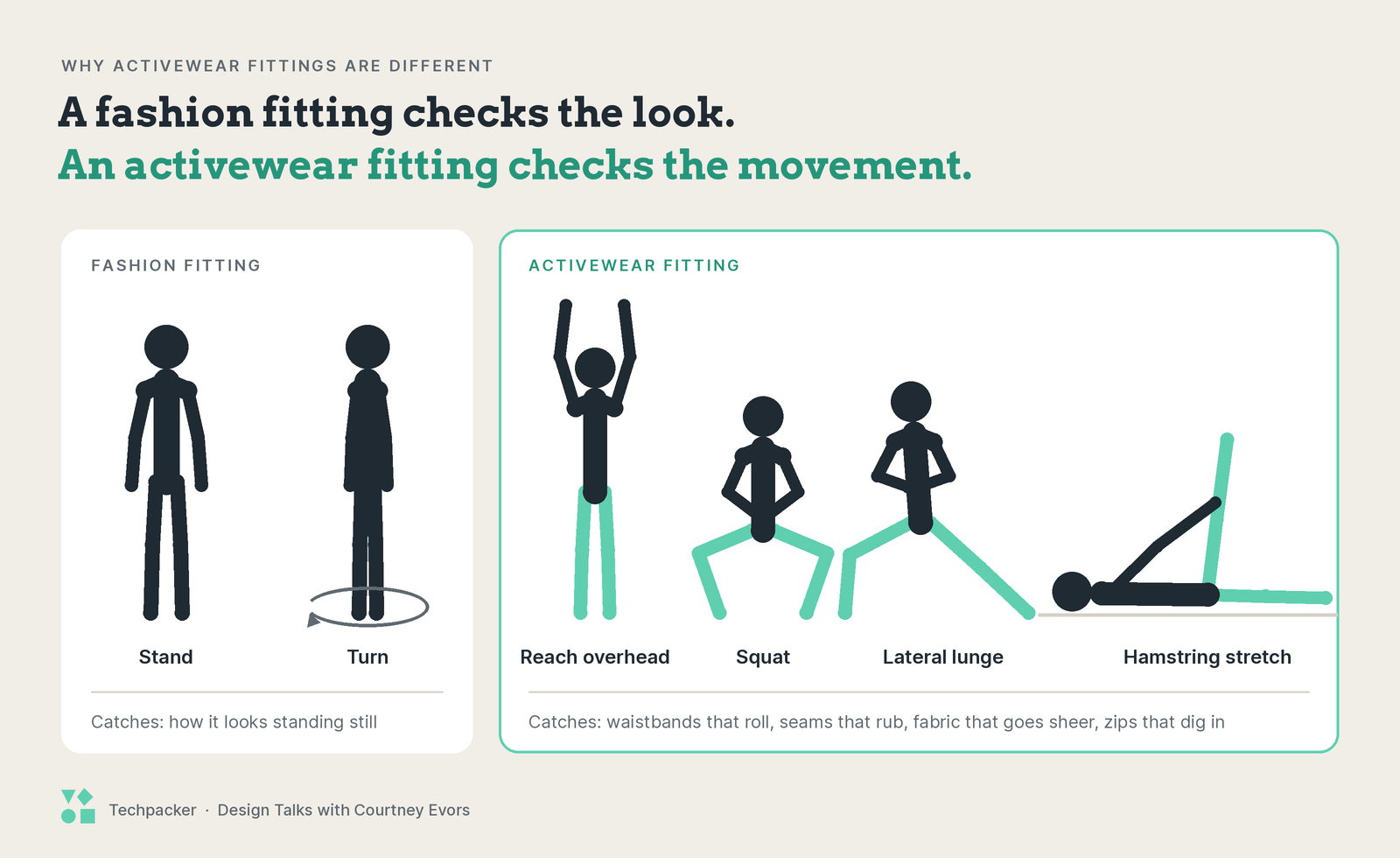
That last example is my favorite because it looks perfectly fine on a sketch. You only find the problem when someone actually uses the garment, which is why activewear fittings look so different from fashion fittings. In a fashion fitting, the model stands, turns around, and the team checks how it looks. In an activewear fitting, the model reaches overhead, squats, stretches and lunges in different directions. As Courtney put it,
"Because if you can't do a lateral lunge in a pair of tights, you've got an issue."
It sounds obvious once you hear it. But a static fitting will never catch the problems that only show up in motion.
What an Activewear Tech Pack Needs to Cover
A sketch tells the factory what a garment looks like. It does not tell them how it has to perform. For activewear, the tech pack has to carry that second layer of information, or the factory will fill it in with its own defaults.
Courtney put it this way.
"There's loads of things that you can open up the Pandora's box of why Active specifically needs a different approach when it comes to building tech packs and designs."
Based on what she described, here is what an activewear tech pack should clearly cover.
- Purpose and use. The sport or activity the garment is built for.
- Seam construction and thread. Where you need flatlock or other low-friction construction, and what thread to use. If you are working on seam communication in general, our post on standardizing seams goes deeper.
- Fabric and stretch. Fiber content and stretch percentage for every fabric.
- Elastics, trims and zippers. What they are, where they go, and why they are there.
- Color across fibers. Polyester and nylon take color differently, so color blocking needs a plan.
- Seam sealing and tape. Where the garment needs them.
Here is what that looks like on a pair of tights in Plmbr, our PLM.
Tights in PLMBR, with callouts linked to materials, fiber content, suppliers and colorways, all flowing into the tech pack
Stretch deserves special attention, because it affects the pattern, not just the fabric. Courtney explained it with a pair of tights. You can have the same fit block, but if one version is in a nylon-elastane with 30% stretch and another is in a polyester-elastane with 15% stretch,
"Like you have to then have a different pattern for that same silhouette."
This is why a fabric change is never a small change in activewear. Same design, same block, different pattern.
The fabric itself needs to be just as specific. Courtney's simplest test for new designers is to ask whether the garment is a knit or a woven. Sometimes the answer she gets sounds like this.
"Is it a knit or woven? Well, I want it to be soft."
Soft is a feeling, not a spec. A spec sounds more like a heavyweight Italian loopback French terry at 350 grams, tightly knit. Even better, Courtney names the exact material and reference number from a specific vendor for each style.
"For this tech pack, for this style, I want this material and this reference number from this vendor."
That leaves nothing to interpret.
The Real Cost of Unclear Activewear Tech Packs
Sampling is where activewear brands lose the most time and money, and the factory often gets the blame. More often, the problem is what the factory was given to work with.
Courtney sees this all the time with founders who come to her after several rounds of sampling.
"And it's like, okay, well that could actually have been two sample rounds. If you went in with the right brief, the right knowledge, the right request for materials upfront."
When a team keeps sampling without getting it right, the first thing she looks at is the tech pack. The gaps are usually the same. Spec information is missing, material or stitch information is missing, or the flat sketch is not clear. Sometimes the whole brief is a sketch, a photo of a garment that already exists and an idea. The flat sketch is one gap you can close before the brief goes out. In RepSketch, you can search premade vector flats, open one in the editor and turn it into your own clean, colored style in a couple of minutes, like this pair of leggings.
Starting from a premade leggings flat in RepSketch
But a clean sketch is only one part of the brief. When the rest is missing, the factory does not send it back as incomplete. In Courtney's words,
"They'll just take it away and make something what they think and interpret what they think you want."
That line sums up the problem for me. Factories are not ignoring your intent. They are guessing it, and every guess costs a round.
The cost builds in a few predictable ways.
- Fit that moves with the fabric. The first sample fits but the material is wrong, so the factory sends a new option. Now the fit changes and it does not drape properly.
- Details nobody asked for. A rushed sample comes back with the factory's own details because they were easier to make. Courtney's question in that moment is the right one. "Why didn't we have a conversation first?"
- Too much depth too early. Factories set minimums per colorway, often 200, 500 or 1,000 pieces. A brand that launches a new style in six colors to meet them can end up sitting on stock it cannot sell.
That last point is about the range, not the tech pack, but it comes from the same root problem, building before deciding. Courtney sees brands develop what they think they want without checking the market first, then go too wide and too deep, too quickly.
"So it's just an assortment of items, but not a collection."
Her advice on colorways was direct. "You should never start out with that kind of depth." Add colors once a style has proven it sells. Otherwise, as she put it, you might as well "give it to a factory and then be stuck with 500 samples that you can't move."
And even a strong tech pack is not a guarantee. The factory may not have the machinery for what you are asking. They may describe the same thing in different terms. US tech packs work in inches while European ones work in centimeters, and compliance requirements change by category, especially in kidswear. A good tech pack starts the conversation with your factory. It does not replace it. That conversation works best when it happens on the tech pack itself, so the factory asks the question before sampling instead of guessing the answer. In Techpack Builder, it looks like this.
The factory asks about the underband elastic on callout 3 of a sports bra tech pack in Techpack Builder, and gets an answer before sampling
How Big Activewear Brands Keep Tech Packs Consistent
Courtney describes Adidas as "a machine," and the details explain why. Design, development and manufacturing teams all worked from the same system, starting with how tech packs were built.
"We worked primarily in Illustrator and built all our tech packs in Illustrator. And then we had plugins that would upload everything into the PLM system, which was great."
When something changed, she said, "you would just need to like hit a refresh in a plugin." Designers stayed in the tool they knew, and the PLM stayed current without anyone retyping the sketch into another document.
I have seen activewear brands on Techpacker work in a very similar way. Their designers keep sketching in Illustrator, and our Illustrator plugin carries that work into their tech packs in Plmbr, our PLM, so the sketch and the tech pack the factory sees stay in step.
Update the print in Illustrator, hit re-sync, and the sketch card in PLMBR updates with it
The second half of the Adidas system was what designers started from. Teams worked from a toolbox of approved materials and trims, with nominated suppliers, so every season started from what was already known to work. As she put it, there was "less guessing in terms of material development or trims and construction."
Her football example shows how far this goes. One core silhouette gets duplicated across different federations and teams, like the main team jersey, the replica that has to match it, and maybe a kids' replica too. If a sleeve cuff changes from a double needle cover stitch to a three-needle flatlock, that change has to reach every version. Instead of updating each tech pack by hand, the team built symbols and libraries so one change carried through all of them. For the Olympics, a master tech pack and a shared library kept trims consistent across countries and sports.
"Have a master tech pack that made it easier for the factory to say, okay, here's this part."
The result is that tech packs did not have to be touched often. Courtney described a first development sample, a second review sample, and maybe one more update to the tech pack. That was it.
What Smaller Activewear Teams Can Borrow
Most growing brands do not have that kind of system, and it is easy to assume these lessons only apply to big teams. Courtney does not think so.
"You can still build an efficient system, even if it's a smaller team, because when you start out being a little bit more rigid on how you build things, as you grow and scale, it helps to minimize the chaos that can come later."
The habits behind it are simple.
- A silhouette library. A base t-shirt, base sports bra, base tight and base jacket, so you are never starting from zero.
- One template for everyone. The same way of entering numbers, and the same logic for trims and graphics.
- Clean files. Courtney described opening another designer's file to find lines that were not connected and sketches that were not grouped, so moving one left a double needle stitch floating somewhere on the page.
Your tools can hold that template for you, too. In RepSketch, your base styles stay as clean, grouped vector flats you can reuse every season. And when the print and Pantones are approved on the colorway page of a sports bra tech pack in Techpack Builder, they go straight onto the sketch in RepSketch, so nothing is re-typed or re-matched along the way.
Combo 2's all-over print and Very Berry Pantone, taken from the tech pack in Techpack Builder and applied to the sports bra sketch in RepSketch
The habit that matters most is keeping the format fixed.
"So you would never change the tech pack format season to season, which then creates a better way of working with your factories because they know what to expect."
When the format stays the same, your developers know what to expect too. In Courtney's words, "Everybody knows how to read the same document." When it does not, every new designer builds tech packs their own way, talks to the factory their own way, and "that's where mistakes start happening."
Why Tech Pack Versions Get Out of Control
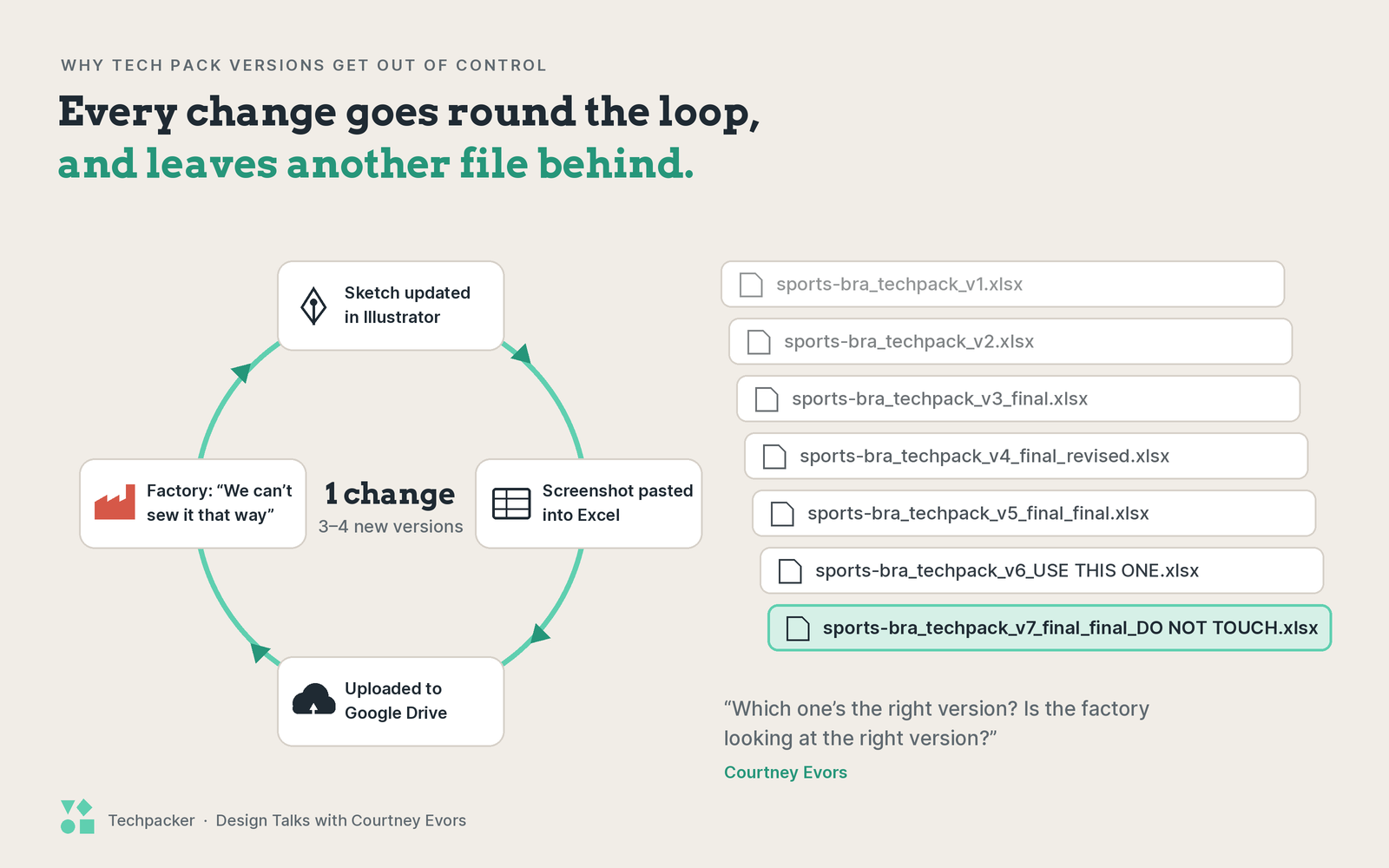
Smaller brands usually manage tech packs in a loop. A design review leads to an update in the Illustrator sketch, which gets screenshotted into Excel or Google Sheets and uploaded to Google Drive. Then the factory says it cannot sew it that way, and the loop starts again. Unless you are set up for it, two people cannot work on the same Excel file at the same time, so when a designer and a developer pass a file back and forth, a single exchange can create three or four versions. Courtney described the questions that follow.
"Which one's the right version? Which one's the most up to date version? Is the factory looking at the right version?"
Most of us know where that ends.
"So before you know it, you can have your style tech pack version seven, final, final, do not touch."
It gets harder as you grow. Courtney pointed out that a designer at a smaller brand might handle 15 styles a season, while at a large brand one designer might manage 60. As she put it, "volume can breed mistakes."
Legacy styles add another layer. Over time, factories sometimes adjust construction for their own efficiency, like switching to a bar tack stitch because that is what their machine can do. The change shows up in the final sample, and the factory might even mention it, but nobody updates the tech pack.
"Those little adjustments don't actually end up getting captured anywhere on the product side."
Years and several designers later, "somewhere something changed and nobody knows who did it and why." The fix is to make every change land in the tech pack as a new version. Here is that bar tack change being saved as Version 2 of a sports bra tech pack in Plmbr, our PLM, with Version 1 still a click away.
A bar tack added to a sports bra’s thread placement in PLMBR, saved as Version 2, with the full version history one click away
We built Plmbr to break exactly this loop. I have seen growing activewear teams use it to keep one tech pack and one current version that the designer, the developer and the factory all work from, instead of passing files back and forth.
A Practical Framework for Activewear Product Development
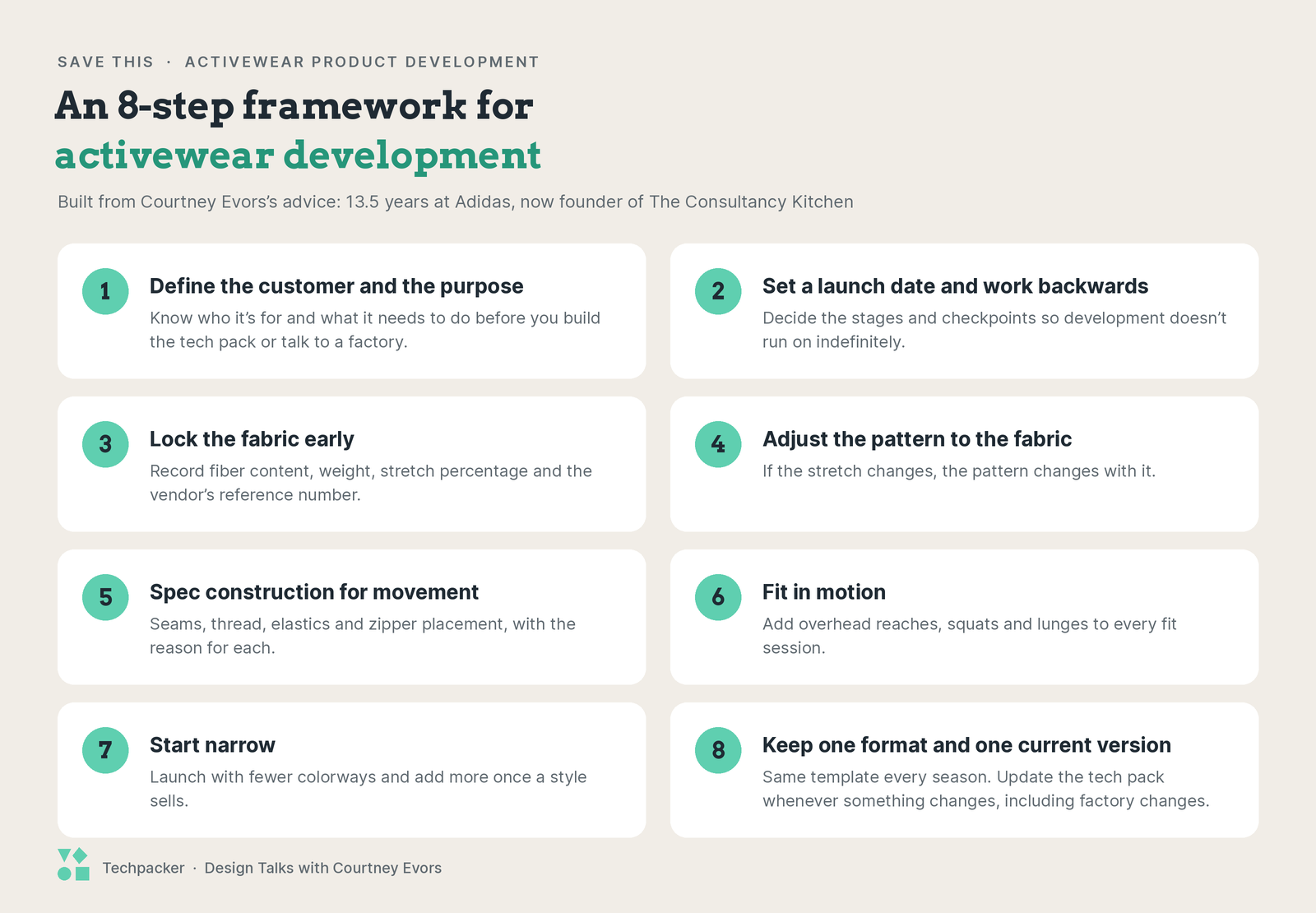
If you want to tighten up your own activewear development, here is a simple place to start, built from Courtney's advice.
- Define the customer and the purpose. Know who the product is for and what it needs to do before you build the tech pack or talk to a factory.
- Set a launch date and work backwards. Decide the stages and the checkpoints, so development does not run on indefinitely.
- Lock the fabric early. Record the fiber content, weight, stretch percentage and the vendor's reference number.
- Adjust the pattern to the fabric. If the stretch changes, the pattern changes with it.
- Spec construction for movement. Seams, thread, elastics and zipper placement, with the reason for each.
- Fit in motion. Add overhead reaches, squats and lunges to every fit session.
- Start narrow. Launch with fewer colorways and add more once a style sells.
- Keep one format and one current version. Use the same template every season, and update the tech pack whenever something changes, including changes the factory makes.
None of this needs an Adidas-sized team. What it needs is starting early. Courtney was clear that the longer a brand waits to fix its way of working, the harder the change becomes.
"Because the bigger your brand gets, the chaos doesn't automatically just control itself."
Every Activewear Product Needs a Reason to Exist
Courtney has played sport her whole life, from field hockey and swimming to competing as a powerlifter on the German national masters team. That is a big part of why she loves this category.
"It's all about building things for purpose and functionality."
Near the end of the conversation, she asked a question about the category itself.
"Do we really need another activewear brand? Probably not."
Her point was not that new brands shouldn't exist. It was that there needs to be a real difference that explains why a brand, or a product, should exist at all. I think that applies all the way down to the tech pack. Every fabric, seam and zipper in an activewear garment should be there for a reason, and the tech pack is where that reason gets written down.
One small story from the conversation stayed with me. On a recent project, Courtney's factory told her that her tech packs were too detailed.
"We've never gotten a tech pack with so much information."
The smaller brands they worked with usually sent so little. If your factory ever tells you the same thing, you are probably doing it right.
If you want to keep every version of your tech pack in one place your team and factory can both follow, Techpack Builder was built for exactly that.
Version history on a sports bra sketch in Techpack Builder, showing who changed what and when
This post is part of our series on how product development works across different categories. If you want to follow along, I would love for you to join our newsletter. We will keep sharing real examples and conversations with people who build products every day.
Related Reading
- Why a Complete Tech Pack Still Gets Made Wrong: Lessons from a Performance Apparel Product Developer, with Aris Sergakis.
- Standardizing Seams in Fashion, with Belu of ABC Seams.