
Contents
Click here for TL;DR
- According to UK manufacturer White2Label Manufacturing, brands without a structured tech pack average 4.5 sampling rounds per style, while brands submitting proper tech packs average 1.8 rounds. That means most small brands are running 2 to 3 completely avoidable revision cycles every season.
- The root cause is rarely factory incompetence. Extra rounds happen because incomplete or text-heavy documentation forces factories to interpret specs rather than execute them.
- Five specific documentation gaps drive most repeat sampling: missing sketch callouts, vague trim specs, absent POM diagrams, no colorway references, and construction notes disconnected from the relevant sketch.
- A visual-first digital tech pack resolves all five by placing images, specs, and annotations in one structured, WYSIWYG canvas rather than across a static PDF spread over separate pages.
- Each unnecessary sample round costs $100 to $250 per sample (per White2Label's data) plus 2 to 4 weeks of development time. For a 10-style collection, that adds up to thousands of dollars and months lost before a single unit goes to bulk.
You send a spec sheet, and the sample comes back wrong. You write up comments, send them back, and wait another 3 weeks. The sample comes back closer, but still not right. By round three or four, you have lost two months and a few hundred dollars per style, and you have started to believe this is just how fashion production works.
The truth is, it is not.
The brands that consistently get samples approved in one or two rounds are not working with better factories. They are sending better documentation. Specifically, they are sending documentation in a format that removes the factory's need to guess.
Most PDF-based and spreadsheet-based tech packs, however detailed, still leave interpretation gaps. The factory fills those gaps with defaults, and those defaults are what you keep rejecting.
This piece covers the five documentation gaps responsible for most repeat sampling, what changes when those gaps are closed with a visual-first digital format, and how to audit your current tech pack against each one.
What the Data Actually Says About Sampling Rounds
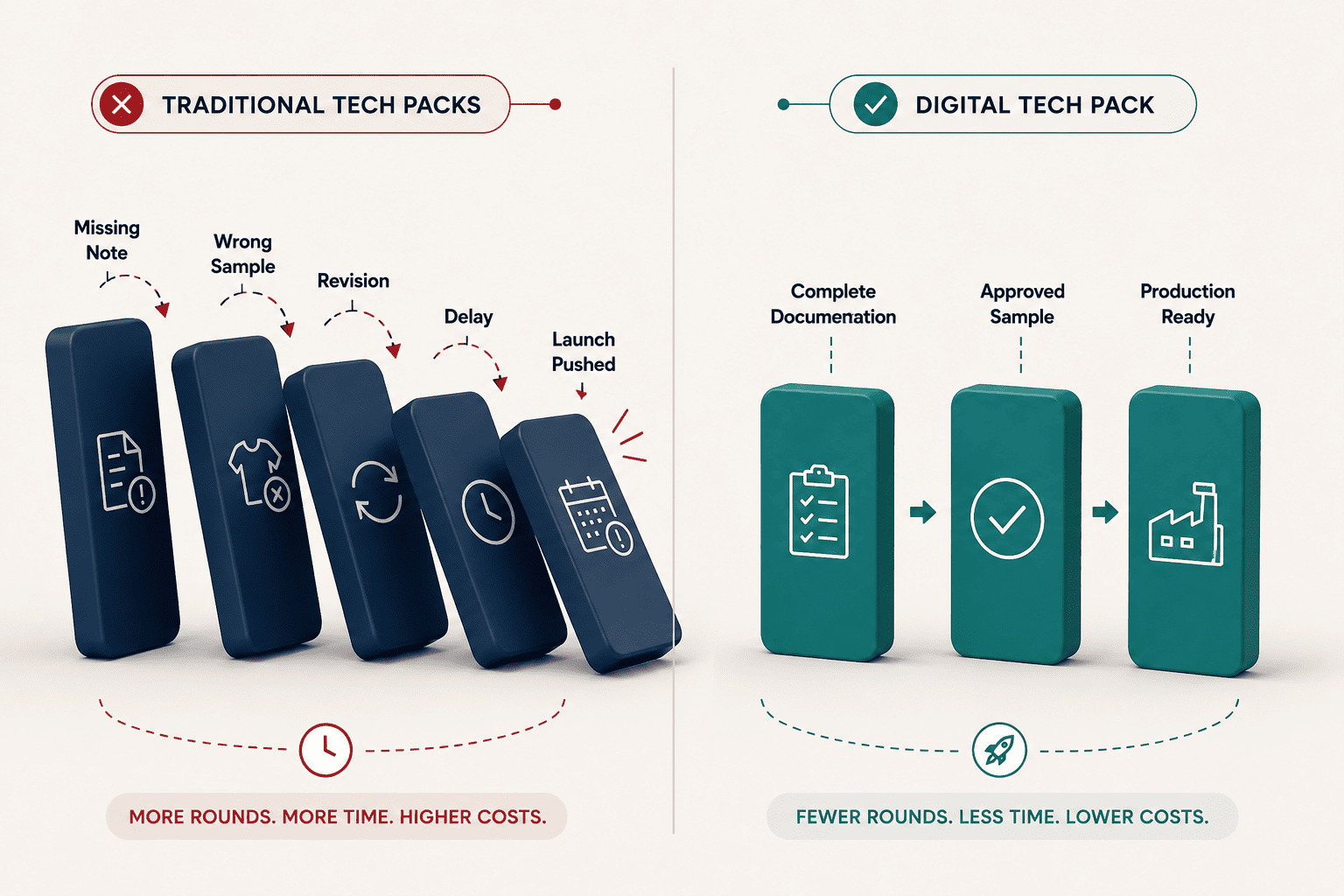
Most small brands are running 2 to 3 more sampling rounds than necessary, and the difference traces back to documentation format, not factory quality.
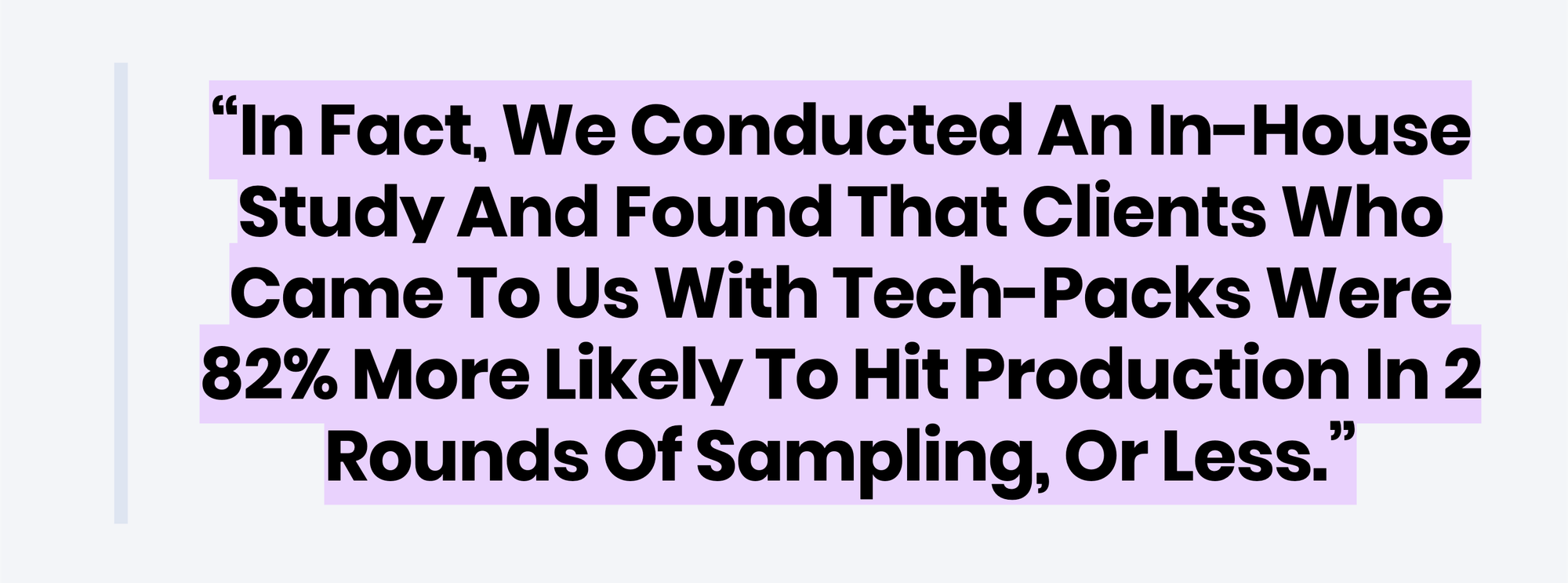
UK manufacturer White2Label Manufacturing tracked sampling outcomes across more than 400 brands and published the results: clients who submitted proper tech packs were 82% more likely to reach production in two rounds or fewer.
The average for clients without a tech pack was 4.5 rounds per style. The average for clients with one was 1.8 rounds. Savings per design ranged from $375 to $950 in sampling costs alone, before accounting for the time lost waiting on revisions.
That data comes from a manufacturer observing their own client base across hundreds of real projects. It is not a survey or an industry estimate.
The pattern it describes matches what sourcing consultants, freelance technical designers, and factory-side pattern makers consistently report: the gap between round one and round three almost always traces back to something missing or unclear in the documentation, not to factory negligence.
What each extra round actually costs a small brand
A single sample runs $100 to $250, depending on complexity, per White2Label's data. Three extra rounds per style cost $375 to $950 in sampling fees alone. For a brand developing 10 styles in a season, that is $3,750 to $9,500 spent on avoidable revisions before a single unit goes to bulk.
The time cost hits harder. Each round takes 2 to 4 weeks, including shipping, factory production time, and feedback processing. Three unnecessary rounds per style add 6 to 12 weeks to your development calendar. For a brand launching a seasonal collection with a fixed retail window, that is not a delay you recover from.
The 5 Reasons Your Sampling Cycle Is Running Long
The factory does not ignore your spec. It interprets it when the spec is incomplete, and every interpretation is a potential revision.
This matters because the default response to a bad sample is "my factory doesn't read carefully." That framing sends designers into a cycle of writing longer text instructions and switching factories, without addressing the actual problem.
The five issues below are format problems, not content problems. You can have all the right information in your tech pack and still generate extra rounds if that information is structured in a way that requires the factory to connect the dots themselves.
1. Missing or Low-Quality Technical Sketches
Factories build patterns from flat technical drawings, not reference photos or mood board images. The flat sketch is what the pattern maker uses to identify panel shapes, seam placement, and construction points.
If the sketch is missing the back view, lacks seam lines, or has no callout labels pointing to specific construction details, the pattern maker defaults to their standard construction method for that garment category.
Their standard method will often produce a sample that looks similar to your reference but is not what you designed. That difference is what drives round two.
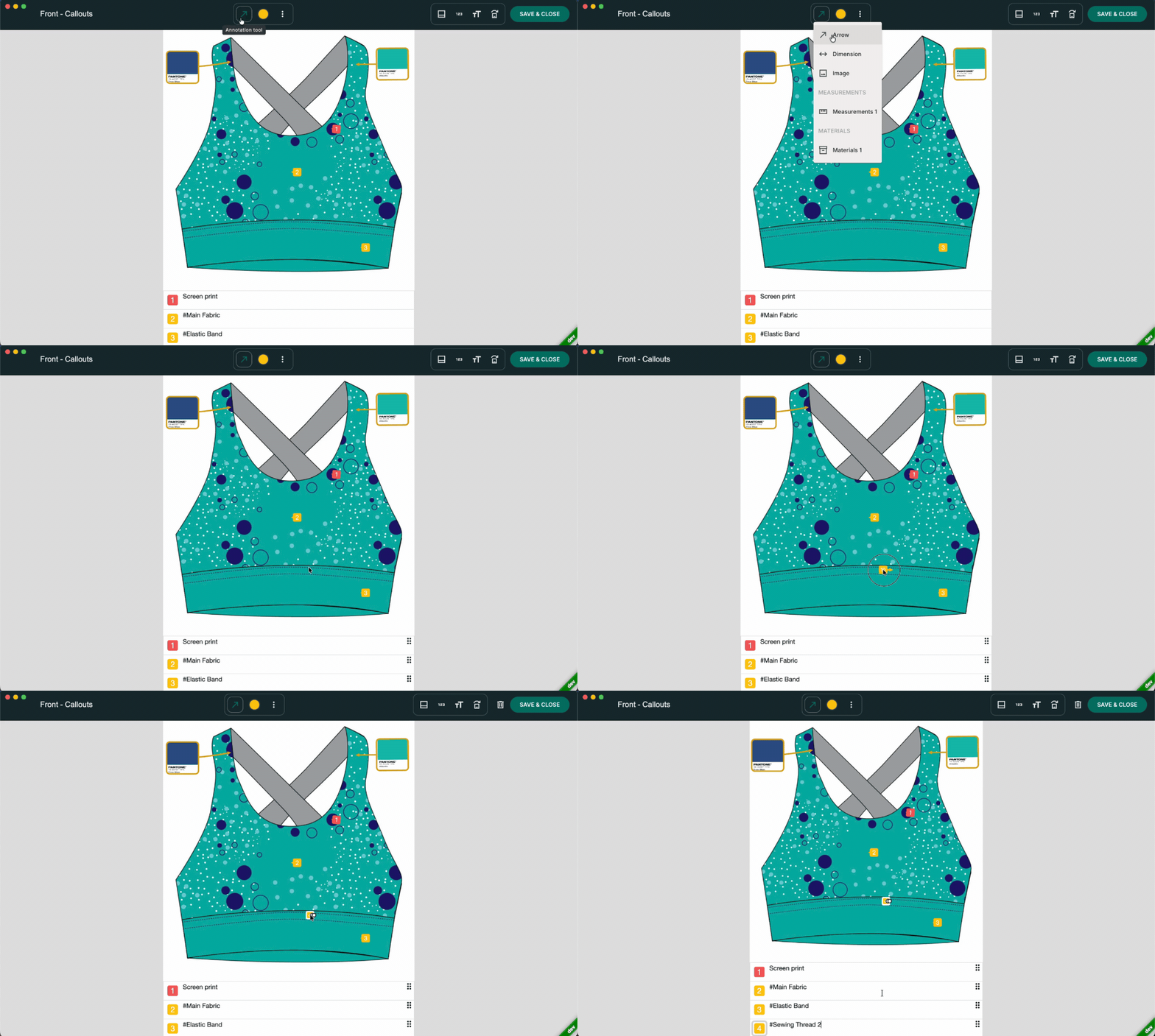
What changes with a visual-first digital format: sketch annotation is built into the canvas. You place a label directly on the panel you are referencing, not in a separate text block two pages later. The connection between the note and the detail is visual and immediate.
2. Vague Trim and Materials Specs
"Brass zipper, 6 inches, antique finish" sounds specific until it reaches a factory sourcing team that has 14 options meeting that description at different price points. Without a reference image attached to that BOM line, the factory selects the closest available match. That match fails your approval, and another round begins.
The same issue applies to fabrics with handle or texture references, hardware with finish variants, and labels with placement dimensions stated in text only. Text specs create a range of valid interpretations. A reference image attached to the spec line creates one.
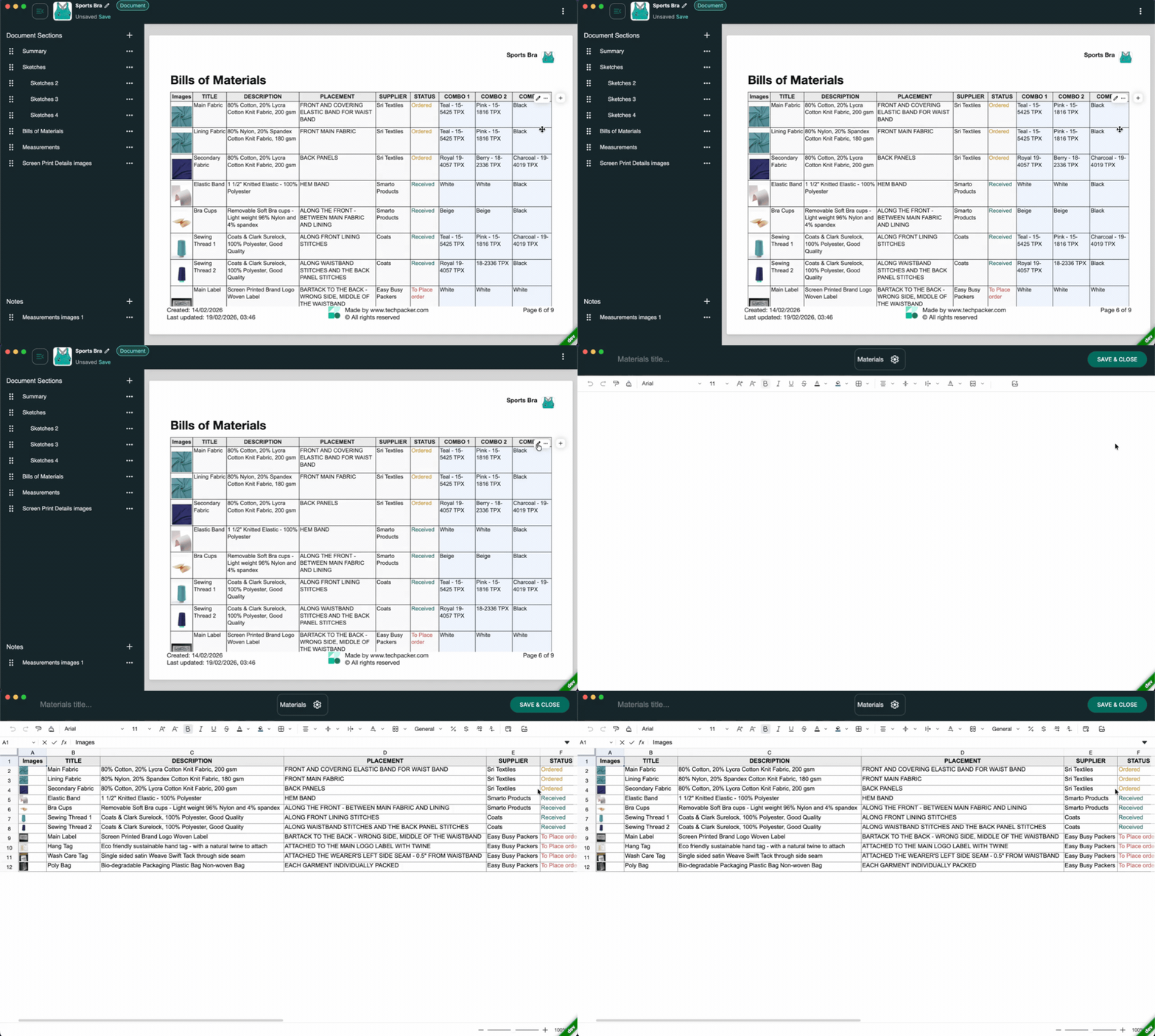
What changes with a visual-first digital format: images are embedded directly inside the BOM block, not in a separate attachment; the factory may or may not open alongside the correct line item.
3. Incomplete or Absent Point of Measure (POM) Charts
A measurement table without a POM diagram is only half a measurement spec.
Two factories will place a chest measurement at different heights unless the diagram shows exactly where the tape begins and ends. "Chest: 21 inches" means something different to a factory in Vietnam than to one in Portugal if neither has a reference showing the measurement point.
Most tech pack creations include measurement tables. Far fewer include a labeled diagram showing each measurement location on the garment sketch. That diagram takes 10 minutes to add and eliminates the majority of first-round measurement discrepancies.
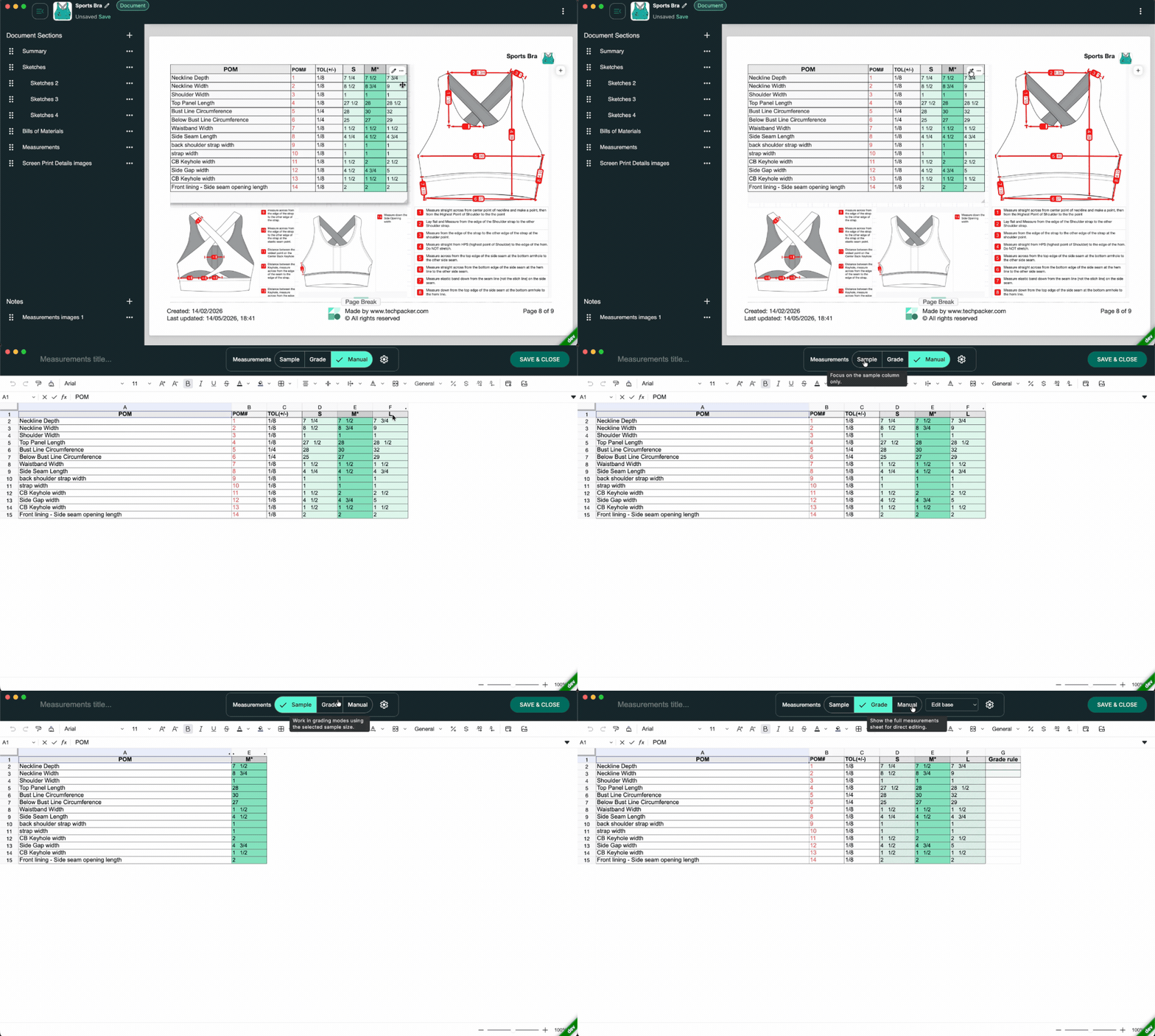
What changes with a visual-first digital format: the measurement table and the annotated POM sketch live in the same section. There is no separate file to attach, no version to lose in an email thread.
4. No Colorway Breakdown
"Dusty mauve" is not a production specification. Different dye houses, different regions, and different fabric suppliers will each interpret a color name differently.
Without a Pantone reference code or a fabric swatch image tied to each colorway, the factory matches to their nearest available stock. That stock will not match your sample standard.
Color approval failures are among the most avoidable revision rounds in apparel development. They require no complex construction decision, only a reference that the factory can match.
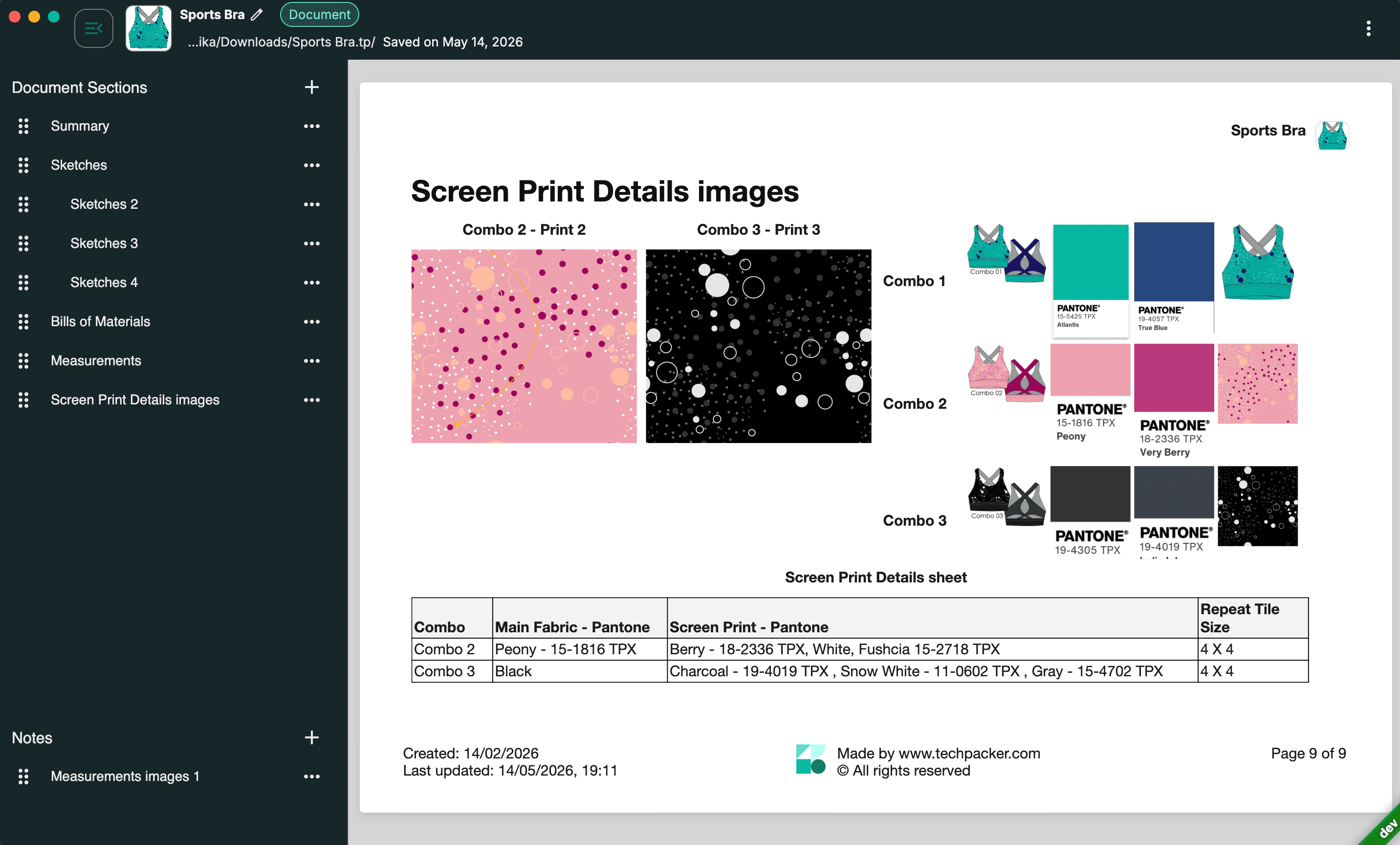
What changes with a visual-first digital format: colorway blocks are structured and visual. Pantone codes, swatch images, and placement references are grouped in one section, not scattered across a garment spec sheet and a separate attachment.
5. Construction Notes Disconnected from the Sketch
A paragraph of construction instructions placed on a separate page from the garment sketch forces the factory's pattern maker to read one document while holding another in mind. Details get dropped. Seam allowances get defaulted. Stitch types get substituted with whatever is standard on that factory floor.
The issue is not that the instructions were unclear. The issue is that the factory had to work to connect them to the relevant construction point.
Documentation that requires extra cognitive work generates more errors, because interpretation fills in wherever attention lapses.
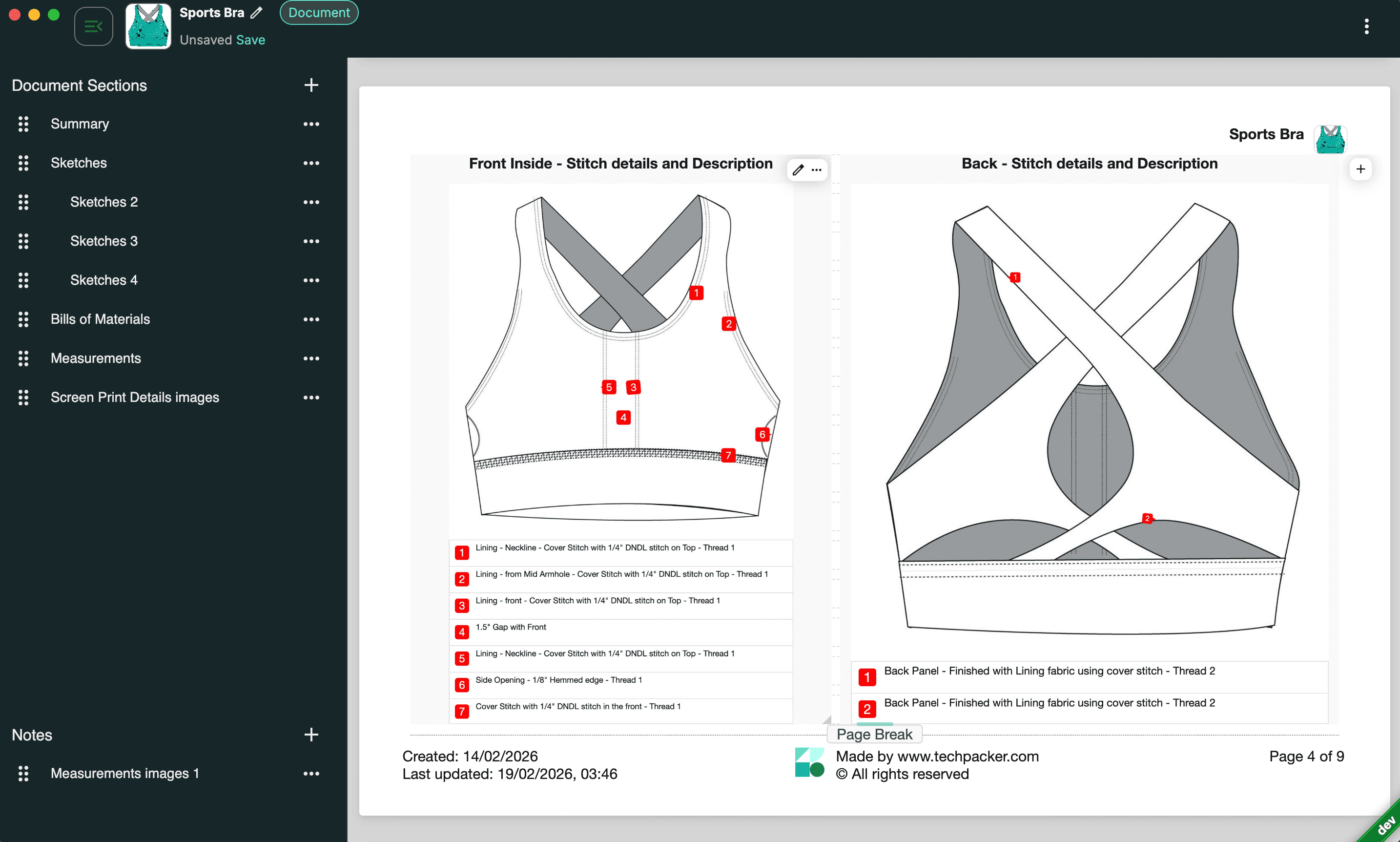
What changes with a visual-first digital format: every section is a canvas where the sketch and its construction notes sit together. The factory reads the spec and sees the relevant sketch detail at the same moment, with no cross-referencing required.
Why a PDF Is Not the Same as a Digital Tech Pack
Many designers believe they already have a digital tech pack because they export their spec from Adobe Illustrator and save it as a PDF. A PDF is a digital file. It is not a digital tech pack in the sense that matters for sampling accuracy.
A PDF is static. A complex spec PDF requires the factory to flip between pages to connect a sketch on page 2 to a construction note on page 7 and a BOM line on page 11. Every page flip is an opportunity for a detail to be missed or misattributed.
A purpose-built digital tech pack is structured at the block level.
Every section is a unit. Sketches, specs, and construction notes live in the same block, not on separate pages. The output is a single .tpv file that reads sequentially, with no page-turning and no cross-referencing between attachments.
There is also a version control problem specific to PDFs. When you update a spec and resend a new PDF, there is no guarantee the factory updates their working file. Purpose-built digital tech pack tools log every external share, so both sides always know which version is current.
How to Audit Your Current Tech Pack Against Each of the 5 Gaps
Before building a new tech pack from scratch, run this audit on whatever documentation you currently send to factories. Most designers find at least two or three of these gaps in their existing process.
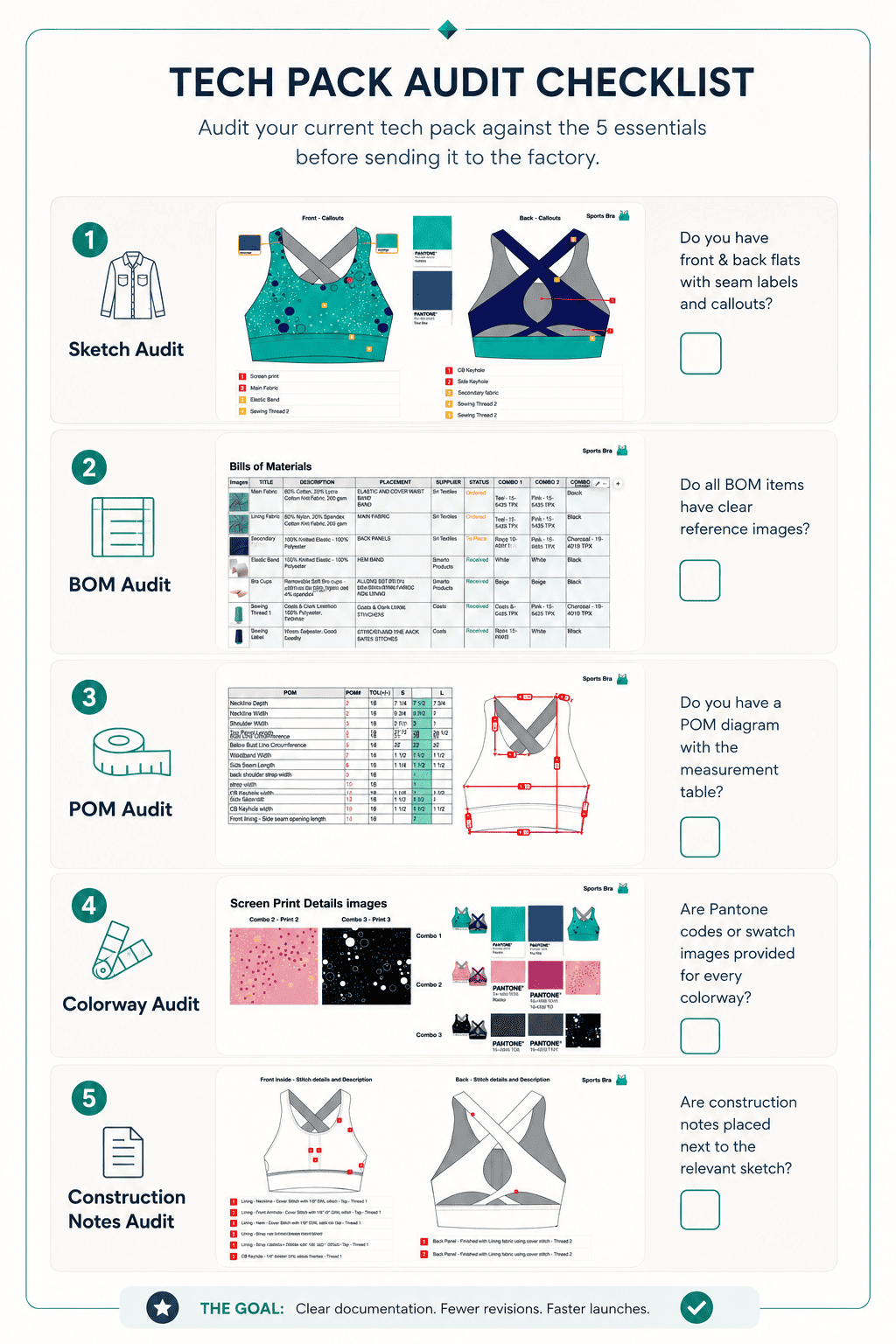
The sketch audit:
Open your current spec and find the flat sketch. Does it include a back view at the same scale as the front? Are seam lines visible and labeled? Are trim placements dimensioned with callout lines pointing to exact placement points? If the answer to any of these is no, the factory's pattern maker is filling in that detail themselves.
The BOM audit:
Go through every line in your bill of materials. For each fabric, trim, hardware piece, and label, ask: is there a reference image attached to this line? If the answer is "the factory can figure it out from the text description," that line is a candidate for a revision round.
The POM audit:
Find your measurement table. Now find the diagram showing where each measurement point sits on the garment. If there is no diagram, every factory you work with is measuring at their own default points.
The colorway audit:
For every colorway listed in your spec, check that a Pantone code or swatch image is attached. "As per reference sample" is not a production specification if the reference sample is not physically at the factory.
The construction notes audit:
Check where your construction notes live relative to the sketch they reference. If the answer is "on a separate page," your factory is reading the notes and the sketch separately, which means connections between them are being made by inference.
The Real Fix Happens Before the Factory Touches Your Spec
The sampling cycle is set before the factory reads your documentation. Every extra round is the result of a decision made in how that documentation was built, not how carefully the factory read it.
Closing the five gaps covered in this piece does not require a new workflow, a bigger team, or enterprise software.
It requires a documentation format that places images, specs, and construction notes in the same visual space, removes cross-referencing, and exports a single structured file that the factory reads sequentially. That shift is what moves a brand from 4.5 rounds to 1.8.

If you are currently building tech packs in Illustrator and Excel, the fastest path to that outcome is downloading Techpack Builder, importing your existing Illustrator flats, and rebuilding the spec around them in a block-based canvas. Free to download, available on Mac and Windows, no limits.
Other basic FAQ's
1. How many sample rounds should a small fashion brand expect?
Most small brands without a structured tech pack run 3 to 5 rounds per style. Brands using detailed, visual-first tech packs average closer to 1 to 2 rounds. White2Label Manufacturing's internal data across more than 400 brands found that clients who submitted proper tech packs were 82% more likely to reach production in two rounds or fewer, compared to an average of 4.5 rounds without one. Two rounds are a realistic target for most styles if the documentation is complete and structured.
2. My factory has years of experience. Why do they still get samples wrong?
An experienced factory still relies on your documentation to know what YOU specifically want. Their experience tells them how garments are typically constructed, not how you want this particular garment constructed.
When your spec leaves room for interpretation, they fill it with their standard method. That standard method may produce a technically correct garment that is not your design. The fix is removing the interpretation opportunity, not finding a more experienced factory.
3. Does a tech pack guarantee a perfect first sample?
No. A tech pack removes documentation variables, not all variables. Fabric availability, factory machinery, and construction complexity can still affect first-sample outcomes.
What a well-structured tech pack does is make sure that when a sample is wrong, the cause is traceable to a specific production variable rather than a documentation gap. That makes corrections faster and less likely to require a full re-sample.
4. What is the difference between a spec sheet and a tech pack?
A spec sheet is one component of a tech pack. It typically covers measurements only. A complete tech pack includes flat technical sketches, a bill of materials, POM charts, colorway references, construction notes, label specs, and packaging details.
Sending a spec sheet alone is one of the most common reasons brands run 4 to 5 rounds: the factory has measurements, but has to guess everything else.
5. Why do measurement errors keep happening even when I send exact numbers?
Measurement errors almost always happen at the measurement POINT, not the measurement value. If your spec says "chest: 21 inches" but does not show exactly where the tape starts and ends on the garment, every factory uses its own default placement point.
A POM diagram that marks each measurement location on the garment sketch eliminates this. It is the single highest-return fix for brands experiencing repeat measurement discrepancies.
6. Can I just add more detail to my existing PDF instead of switching formats?
Adding detail to a PDF helps, but it does not solve the format problem. A PDF requires the factory to connect information across pages, because the sketch, the spec, and the BOM are on separate pages. More text on more pages means more cross-referencing, not less.
The structural advantage of a block-based digital tech pack is that related information lives together visually, so the factory reads the sketch and the spec at the same moment rather than navigating between them.